

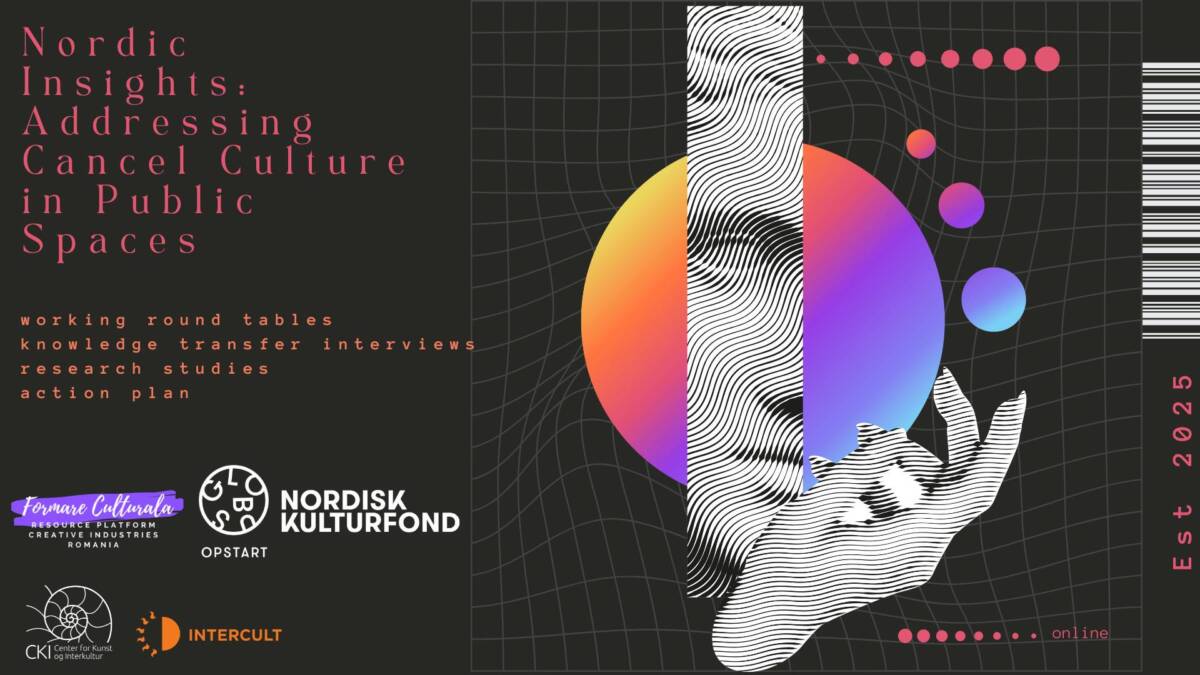
Within the “Nordic Insights: Addressing cancel culture in public spaces through artistic dialogue and cultural innovation” project, hosted by Formare Culturala Platform from Romania, a virtual roundtable took place, being the first in a series of roundtables dedicated to intercultural dialogue about controversial public art.
Niels Righolt, cultural facilitator, provided the broader Nordic context, explaining how “cancel culture” in public spaces refers to challenging, removing, or recontextualizing public symbols that seem to conflict with contemporary values. He gave examples from Denmark about controversies related to colonial history, including the episode when King Frederick V’s statue was thrown into Copenhagen’s harbor, and from Norway, where the monolith in Vigeland Park became a controversial nationalist symbol. He emphasized the transition from classical monumental thinking toward more inclusive and interactive public spaces, as well as debates about women’s representation in public spaces throughout the Nordic region.
Hanna Granlund (heritage expert) began by explaining the historical evolution of public monuments in Sweden, emphasizing that contemporary controversies have their roots in a lengthy nationalization process that began in the 17th century. In Sweden, unlike other Nordic countries directly affected by World War II, public art development was shaped by welfare state legislation from the 1930s, including the famous “1% rule” that allocated a percentage of public construction budgets to art. Hanna presented several fascinating case studies, from the “Iron Square Fountain” in Göteborg – initially a monument to Swedish iron industry that became controversial due to stereotypical representations of continents and connections to slave trade – to the anti-racist monument project in Malmö, which addressed collective trauma resulting from the series of racist crimes in the 2000s. She explained collective trauma theory and how reality denial can create dissonance between communities, as well as the dynamic tension between grassroots movements and official institutions in creating memorial public art.
Cezar Buiumaci (historian) offered a “journey through the history of public monuments” in Romania, demonstrating how different political regimes – from foreign occupation to communism and post-communism – shaped the country’s monumental landscape. He began with stone crosses from the 16th-19th centuries, the first Romanian public monuments that survived due to their profound significance in Romanian culture, unlike secular monuments that were often destroyed during periods of political transition. Cezar presented the fascinating evolution from Russian occupation monuments of the early 19th century, through systematic destruction of monarchical symbols during the communist period and their replacement with statues of new leaders, to post-communist controversies. Remarkable cases included the monument to victims of communism – highly contested due to its form and political context – and the famous “Daco-Roman Symbiosis” with Emperor Trajan and the she-wolf, which although initially rejected for the emperor’s nudity, became the most photographed monument in Bucharest before being removed due to technical issues. He emphasized the importance of “monument propaganda” – the process by which past communities informed their citizens about future monumental projects through conferences, exhibitions, and full-scale models.
Host: Oana Nasui, cultural researcher
///
More about the “Nordic Insights” project here











Recent Comments